

Winning at an online casino is never guaranteed, but the way you play has a real effect on how often you come out ahead and how smoothly you get to keep what you win. At Jackpot City, that comes down to three things you can actually control: which games you choose, how you manage your bankroll and bonuses while you play, and how you handle verification and withdrawals once there is money to cash out. Get those three right and you are playing the odds as well as they can be played, rather than leaving results to chance alone.
This guide walks through each of those areas in the order they matter, starting with the game choices that make the biggest difference and finishing with the practical steps that turn a win on screen into money in your account.
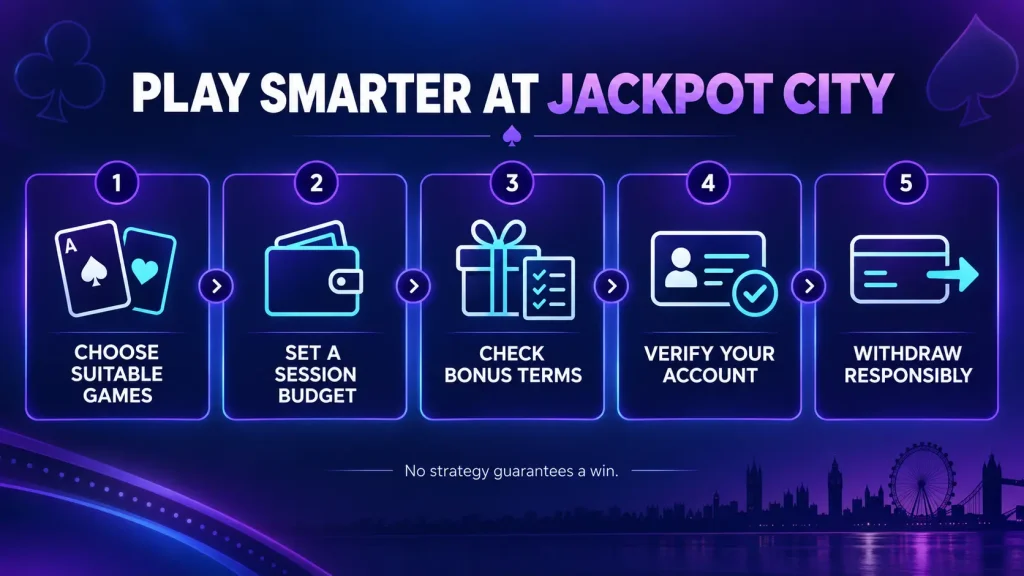
What Game Pays the Best on Jackpot City
There is no single answer to what game pays the best on Jackpot City, because different game types return money to players in different ways. What you can do is understand how each category behaves, then choose based on what you actually want from a session: frequent smaller wins, a shot at a life-changing jackpot, or the best mathematical odds against the house.
Table games generally offer the most favourable odds of any category on the site. European-rules blackjack, played with correct basic strategy, carries a house edge of roughly 0.5% to 1%, which is about as close to even money as a casino game gets. That means over a long run of hands, you retain a high percentage of what you wager, and a well-played strategy noticeably outperforms guesswork. Roulette works differently: it is a game of pure chance with no skill element, but the wheel type still matters. European roulette, with its single zero, gives the house a smaller edge than the American double-zero wheel, so all else being equal, a single-zero table is the better choice if you have a preference between the two.
Slots work on a different principle entirely. Every slot has a Return to Player (RTP) figure, a theoretical percentage of all money wagered on that game that gets paid back to players over its lifetime, shown in the game’s information or paytable screen before you spin. Online slots commonly sit somewhere in the 94% to 97% RTP range, with a smaller number of titles running higher. Checking this figure before you settle into a game, rather than picking purely on theme or graphics, is the single most useful habit for slot play. Volatility matters alongside RTP: low-volatility slots pay out more often in smaller amounts, while high-volatility slots pay less frequently but can deliver much bigger individual wins. Neither is objectively better; it depends on whether you would rather stretch a session with frequent small returns or accept longer dry spells for a shot at a bigger hit.
Progressive jackpot slots, including well-known titles like Mega Moolah, sit in a category of their own. A portion of every stake across a linked network of games feeds a jackpot pool that keeps growing until someone triggers it, which typically means a lower base RTP on the standard game symbols in exchange for the chance at a jackpot that can run into a genuinely life-changing sum. If your goal is the best realistic odds session to session, a lower-volatility slot or a table game will usually serve you better. If you are playing specifically for a shot at a huge single win, a progressive jackpot is the only category that offers it.
The table below sums up how the main game types compare, so you can match your choice to what you are actually trying to achieve.
| Game type | How the odds work | Typical volatility | Best suited to |
|---|---|---|---|
| European blackjack | Low house edge (roughly 0.5–1%) when played with correct strategy | Low to medium | Players who want the best mathematical odds and are willing to learn basic strategy |
| European roulette | Fixed house edge built into the single-zero wheel; no skill element | Medium | Players who want simple, chance-based play with better odds than the double-zero wheel |
| Standard slots | RTP varies by title, shown in the game’s paytable | Low to high, depending on the game | Players who want variety and control over how often they win versus how big |
| Progressive jackpot slots | Lower base RTP in exchange for a growing shared jackpot | High | Players prioritising the chance of a large single win over frequent smaller returns |
How to Win Big on Jackpot City: Bankroll and Session Habits
Choosing the right game is only half the picture. How you manage your money while you play has just as much influence on whether a session ends in your favour, and it is entirely within your control regardless of which games you prefer.
The starting point is treating your bankroll as a session budget rather than an open-ended pot. Decide before you start playing how much you are comfortable spending, and treat that figure as the ceiling for the session rather than something to top up on impulse if it runs low. Pairing that with a target, a point at which you will stop if you are up a meaningful amount, protects wins you have already made rather than letting them get fed back into the game. This kind of pre-commitment is one of the most consistently effective habits for anyone serious about coming out ahead over time, because it removes in-the-moment decisions that tend to favour the house.
Demo or practice mode is worth using whenever you try a slot or table variant you have not played before. It costs nothing and lets you see how a game’s volatility actually feels, how bonus features trigger, and how the paytable translates into real outcomes, before you commit real stakes to learning those things. This is especially useful with newer slot mechanics or less familiar table variants, where the rules or bonus structure might not be obvious at a glance.
A few habits worth building into every session:
- Set a fixed session budget before you start, and stick to it regardless of how the session is going.
- Decide a stop-win point in advance, so a good run gets banked rather than gradually given back.
- Use demo mode to learn any unfamiliar game before staking real money on it.
- Take regular breaks rather than playing in one long, uninterrupted stretch, which helps you stick to the first three habits.
Your account settings also include tools such as deposit and loss limits, which are worth setting proactively rather than only reaching for them if a session starts to feel like it is getting away from you. Used from the start, they function as an extension of your own bankroll discipline rather than a last resort.
Making Bonuses and Loyalty Points Work in Your Favour
Bonuses and loyalty rewards are one of the more overlooked parts of winning at Jackpot City, largely because the mechanics behind them are not always intuitive. Understanding how they actually work means you get more value from them and avoid the most common frustration players run into, which is a bonus win that will not withdraw.
When you claim a bonus, whether a matched deposit or a batch of free spins, any winnings it generates are usually subject to a wagering requirement: a specified multiple of the bonus amount that you need to wager on real-money play before those winnings convert into withdrawable cash. Not every game contributes equally toward clearing that requirement; slots typically count fully, while table games often contribute at a reduced rate or may be excluded from a specific promotion altogether. This is why it is worth reading the terms attached to a particular offer before opting in, rather than assuming every bonus works the same way. Free spin winnings sometimes come with no additional wagering attached at all, paid straight into your cash balance, but this depends entirely on the specific promotion running at the time, so check the current terms rather than relying on how a previous offer worked.
Loyalty points work on a separate, simpler track and reward you regardless of whether you are chasing a specific promotion. The moment you make your first real-money deposit, you are enrolled automatically, and every wager you place from that point earns loyalty points, with slots generally earning at the fastest rate. Those points accumulate and convert into bonus credit once you reach a redemption threshold, and as you move up through the programme’s tiers, the perks improve: think faster support response, more frequent personalised offers, and access to promotions not available to newer accounts. Because points build passively from wagers you were placing anyway, the programme rewards consistent, sensibly sized play more than occasional large bets, which lines up neatly with the bankroll habits above. Checking the promotions section of your account regularly is worth doing, since daily and time-limited offers appear there and are easy to miss if you only ever play through the main game lobby.
Turning a Win Into Cash: Verification and Withdrawals
None of the above matters if a win does not actually make it into your bank account, and this is the step that catches out more players than any question of game strategy. Getting this part right is straightforward, but it needs a little preparation rather than being left until the moment you want to withdraw.
Before your first withdrawal is released, you will need to complete identity verification, generally a piece of government-issued photo ID and a recent proof of address. This is a standard step for licensed UK casino accounts and applies to every player, not something triggered by a large win or unusual activity. The single most useful thing you can do is complete this verification early, through your account settings, rather than waiting until you have a withdrawal request pending. Submitted in advance, it is a quick formality; left until a payout is sitting in review, it becomes the reason your money takes longer to arrive than it needed to.
Withdrawal method matters too. Payouts are usually returned via the same method you used to deposit, so it is worth thinking about that at the point you first fund your account. E-wallet withdrawals typically clear faster than card payments or bank transfers, so if speed of access to your winnings matters to you, that is worth factoring into which deposit method you choose from the outset. There are no fees charged on withdrawals themselves, though it is worth checking whether your own bank or e-wallet provider applies anything on their end.
If a withdrawal does take longer than expected, the cause is almost always one of a small number of things, and each has a straightforward fix:
- Verification not yet complete – if your ID or proof of address has not been fully processed, the withdrawal will sit pending until it is. Uploading clear, matching documents through your account settings resolves this.
- Wagering requirement still outstanding – if any bonus you claimed still has an active wagering requirement attached, related winnings will not release until it is cleared. Checking your bonus status before requesting a withdrawal avoids the surprise.
- Method mismatch – requesting a withdrawal to a different card or account than the one you deposited with can cause a delay or decline. Withdrawing via the same method you used to deposit is the simplest way to avoid this.
Handled in this order, verification done early, wagering requirements checked before you request a payout, and a consistent payment method, most withdrawals move through without any of these hold-ups. Combined with the game selection and bankroll habits covered earlier, this completes the practical side of playing Jackpot City well: choosing games that give you a genuinely better shot, managing your money so a good session stays a good session, and making sure the win in your account is a win you can actually spend.